

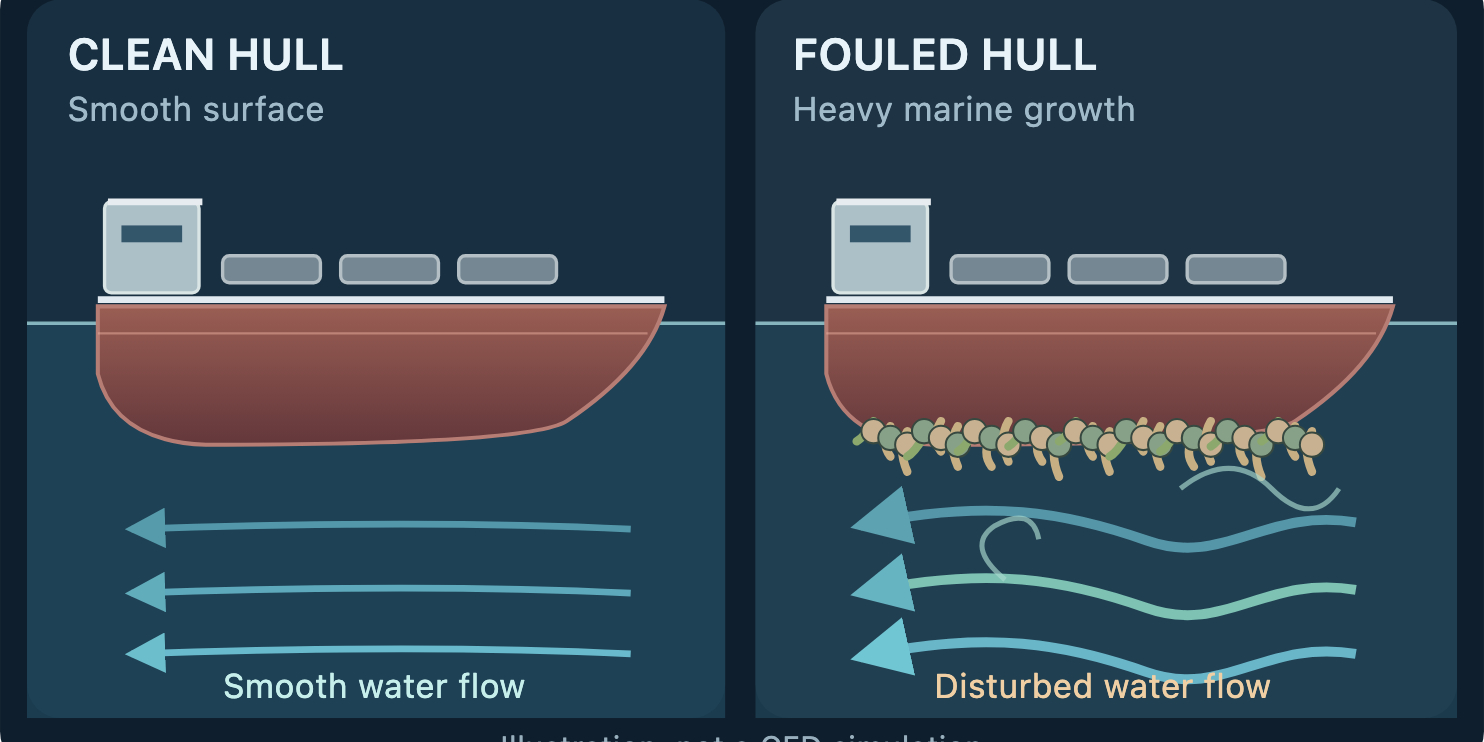
Underwater hull cleaning is more than routine vessel maintenance. For a bulk carrier operating on long voyages, marine growth on the hull can increase resistance, raise fuel consumption and gradually erode voyage efficiency. The problem is easy to miss: the fouling develops below the waterline, while its impact often appears first in performance data.
How much additional fuel could a fouled hull cost? And when does cleaning a vessel while it remains afloat make operational sense? The answers depend on the ship, its coating, trading pattern and actual hull condition. Our interactive simulator below makes the financial effect easier to explore without pretending that every vessel suffers the same penalty.
What causes hull fouling, and why does it matter?
Biofouling is the accumulation of living organisms on wetted surfaces. It can begin with a nearly invisible microbial film and progress to algae, weed, barnacles, tubeworms or other hard growth. The flat bottom, vertical sides and difficult-to-reach areas of a vessel may develop different fouling patterns.
Even when the hull appears sound from a structural perspective, its submerged surface may no longer have the smoothness intended by the coating system. Marine growth increases surface roughness, creating additional frictional resistance as the ship moves through water.
For a large commercial ship, that matters because the engine and propeller must overcome not only the ship’s natural resistance but also the additional drag created by fouling. Underwater hull cleaning removes attached growth where an appropriate method can be used without unacceptable risk to the coating or environment.
How underwater hull cleaning affects speed, power and fuel consumption
The connection between hull condition and propulsion is straightforward, but two operating scenarios should not be confused:
- At approximately constant speed: A fouled hull generally requires more delivered power, which can mean greater fuel consumption to maintain the same voyage speed.
- At approximately constant shaft power: The vessel may lose speed instead, potentially affecting arrival times and voyage planning.
- When the propeller is also fouled: Reduced propulsive efficiency may compound the hull-resistance problem, making it harder to separate the causes without inspection and reliable performance data.
A clean hull does not eliminate resistance. It helps keep hull-surface resistance closer to the expected condition for the vessel’s coating and operating profile. This is why underwater hull cleaning is relevant not only to technical maintenance teams but also to fleet performance, voyage economics and emissions management.
What does the IMO research actually show?
The International Maritime Organization has drawn attention to the energy penalty of biofouling. A 2022 IMO explanation of an international study reported that a slime layer only 0.5 mm thick, covering up to 50% of a hull, could increase greenhouse-gas emissions by 25–30% in the modelled circumstances.
The outcome depends on ship type, speed and other conditions; it is not a standard penalty for all fouled ships.
“Keeping a ship’s hull clean can also reduce the ship’s greenhouse gas emissions by improving fuel efficiency.” — International Maritime Organization
That distinction matters. An underwater photograph tells us what is growing on a hull; it does not, by itself, provide a defensible percentage of fuel wasted. The vessel’s operating data and the nature and extent of fouling are needed for an informed assessment.
Underwater hull cleaning simulator: explore the hidden fuel cost
The interactive model below compares a clean bulk-carrier hull with several illustrative fouling scenarios. Change the assumed hull condition, clean-hull fuel consumption and bunker price to see how an increase in fuel use can affect daily operating cost.
Try it: Start with 30 tonnes of fuel per sailing day and a bunker price of $650 per tonne. Then compare the clean-hull case with a hypothetical 20% fuel-use penalty. The resulting difference is six tonnes per day, or $3,900 at that assumed price.
Important: The simulator’s 10%, 20% and 30% settings are user-selectable assumptions, not laboratory measurements, class-approved assessments or predictions for any specific bulk carrier. It holds vessel speed and other conditions constant to isolate the potential fuel-cost effect. It should not be used as a substitute for performance analysis or an underwater survey.
How much could hull fouling cost a bulk carrier?
Consider a vessel consuming 30 tonnes of fuel per day with a clean hull and paying $650 per tonne. The following table demonstrates what happens if fuel use increases by different assumed percentages while the vessel maintains the same speed.
| Scenario | Assumed fuel penalty | Fuel/day | Extra fuel cost/day |
|---|---|---|---|
| Clean-hull baseline | 0% | 30 t | $0 |
| Scenario A | +10% | 33 t | $1,950 |
| Scenario B | +20% | 36 t | $3,900 |
| Scenario C | +30% | 39 t | $5,850 |
Illustrative figures: 30 t/day clean-hull baseline and $650/tonne fuel. The WordPress-ready HTML version includes this table with responsive styling.
In the 20% example, the extra cost is $3,900 per sailing day. Across 30 comparable sailing days, that totals $117,000 in additional fuel expenditure.
These are arithmetic examples, not savings promises: real-world results depend on the actual fouling penalty, voyage conditions, fuel price and effectiveness of the cleaning operation.
This is the financial reason to consider underwater hull cleaning before heavy growth becomes established. The decision should weigh probable fuel and operational benefits against inspection, cleaning, access, coating-protection and any voyage-disruption costs.
When should underwater hull cleaning be considered?
There is no reliable rule that every bulk carrier should be cleaned after the same number of months. Fouling develops according to coating type and age, seawater temperature, trading areas, port residence time, vessel activity and the local biological environment.
For owners, managers and technical superintendents, warning signs can include:
- A sustained deterioration in speed–power or fuel–speed performance after accounting for weather, draft, trim and sea state.
- Extended periods at anchorage or alongside, especially in waters with high biological activity.
- Visible slime, algae or hard fouling found during an underwater inspection.
- Fouling in niche areas such as sea chests, cooling-water gratings, bow thrusters and rudder arrangements.
- Increasing difficulty meeting established voyage-performance targets under comparable conditions.
An inspection helps determine whether underwater hull cleaning is warranted, which surfaces need attention and whether the selected method is compatible with the existing anti-fouling coating.
Performance monitoring also helps prevent misleading conclusions. A fuel-consumption increase might be caused by fouling, but weather, loading condition, engine performance, propeller condition and operational decisions can produce similar symptoms.
What happens during professional underwater hull cleaning?
A sound underwater maintenance operation begins with a condition assessment rather than simply putting brushes against the hull.
The practical sequence depends on the vessel and port, but typically includes:
- Review the vessel and coating. Confirm the coating type, maintenance history, intended work area and any limitations on mechanical cleaning.
- Inspect the submerged surfaces. Identify slime, soft growth and hard fouling, including niche areas that need special attention.
- Plan the approved cleaning method. Select suitable equipment and procedures in line with coating recommendations, local requirements and environmental protections.
- Carry out controlled cleaning. Remove appropriate marine growth while seeking to avoid damage to protective coatings and unnecessary release of biological material or paint residues.
- Verify and document the result. Record the condition before and after the operation and address any areas that could not safely be cleaned.
Under suitable conditions, underwater hull cleaning can be performed while a vessel remains afloat, avoiding the need to dry-dock solely for the cleaning task. That does not mean every coating, fouling type or port environment permits the same approach.
At NSD, hull cleaning forms part of our wider underwater vessel services, which also include inspections and propeller maintenance. The correct scope of work is determined by the condition and requirements of the vessel.
Is underwater hull cleaning always environmentally acceptable?
No. Biofouling management offers potential fuel-efficiency and environmental benefits, but the cleaning operation itself must be planned responsibly.
Aggressive cleaning can damage the anti-fouling coating, reduce its service life or release paint particles and marine organisms into the water.
The IMO’s 2023 Biofouling Guidelines establish a common framework for managing hull fouling and reducing the movement of invasive aquatic species. The IMO also approved additional guidance on in-water cleaning in April 2025, addressing safe planning, coating compatibility and environmental risks.
These are guidance instruments; local or national rules and permissions still need to be checked for the specific operation.
Consequently, underwater hull cleaning should be treated as a controlled technical intervention, not simply a visual clean-up. The question is not only whether growth can be removed, but whether it can be removed safely and appropriately at that location.
Hull cleaning and propeller polishing: two different efficiency issues
The hull and propeller interact, but their maintenance needs are not identical.
Hull fouling primarily raises the resistance of the vessel moving through the water. Propeller roughness and deposits can reduce the efficiency with which shaft power is converted into useful thrust.
A vessel may need both services, or only one. Inspecting the propeller alongside the hull helps avoid attributing all speed and fuel penalties to a single component.
For a closer look at the second issue, see our propeller polishing work.
A 2024 research study using a bulk carrier case examined how hull and propeller degradation can be assessed together to support maintenance decisions. It reinforces why underwater hull cleaning is best planned using both condition evidence and performance trends.
What should ship managers measure after cleaning?
The most useful question is not simply, “Does the hull look cleaner?” It is, “Did the vessel perform better under comparable conditions?”
A practical review may compare:
- Speed through water and delivered shaft power at comparable loading and weather conditions.
- Daily fuel use normalized for speed, draft, trim and sea state.
- Photographic evidence and documented fouling coverage before and after cleaning.
- Any coating damage, remaining growth or restricted cleaning areas.
- The cost of the operation against estimated changes in fuel and voyage performance.
Because fuel consumption depends on several variables, a single day’s noon report rarely proves a cleaning benefit. A consistent before-and-after comparison is more reliable.
This approach makes underwater hull cleaning part of a measurable maintenance strategy rather than a one-off cosmetic action.
Underwater hull cleaning services from NSD
Since 1991, NSD | Nick Segredakis Diving Ltd has provided commercial underwater services to vessels and offshore units in Greek ports and locations internationally.
We combine underwater inspection, hull maintenance and propeller services to help technical teams assess and address problems while a ship is afloat.
If fuel consumption is rising, voyage speed is deteriorating or an underwater survey has identified significant growth, we can help establish the hull’s condition and discuss an appropriate scope of intervention.
Explore our underwater services or contact NSD to discuss your vessel and operating requirements.
Frequently asked questions about underwater hull cleaning
Does underwater hull cleaning reduce fuel consumption?
It can. Removing fouling can reduce the added resistance associated with marine growth, but the measurable fuel benefit depends on the vessel’s actual condition, coating, speed and operating circumstances.
Can underwater hull cleaning be done without dry docking?
Yes, in-water cleaning can be carried out with the vessel afloat when technical conditions, coating compatibility and local permissions allow. Some situations still require alternative maintenance arrangements.
How often should a ship’s underwater hull be cleaned?
There is no universal interval. A schedule should reflect hull-coating guidance, inspection findings, trading routes, idle periods and recorded speed–power performance.
How can you tell whether a bulk carrier has hull fouling?
An underwater inspection provides direct evidence. Trends in comparable speed, shaft power and fuel-consumption data can also indicate increasing resistance, but are not conclusive without further checks.
Is underwater hull cleaning allowed in every port?
No. Requirements vary by jurisdiction, port, cleaning method and waste-management arrangements. Confirm permissions and environmental conditions before any in-water operation.
A clean hull is a performance asset. If you need an inspection, a technical assessment or a plan for underwater hull cleaning, contact our team to discuss what your vessel actually needs.